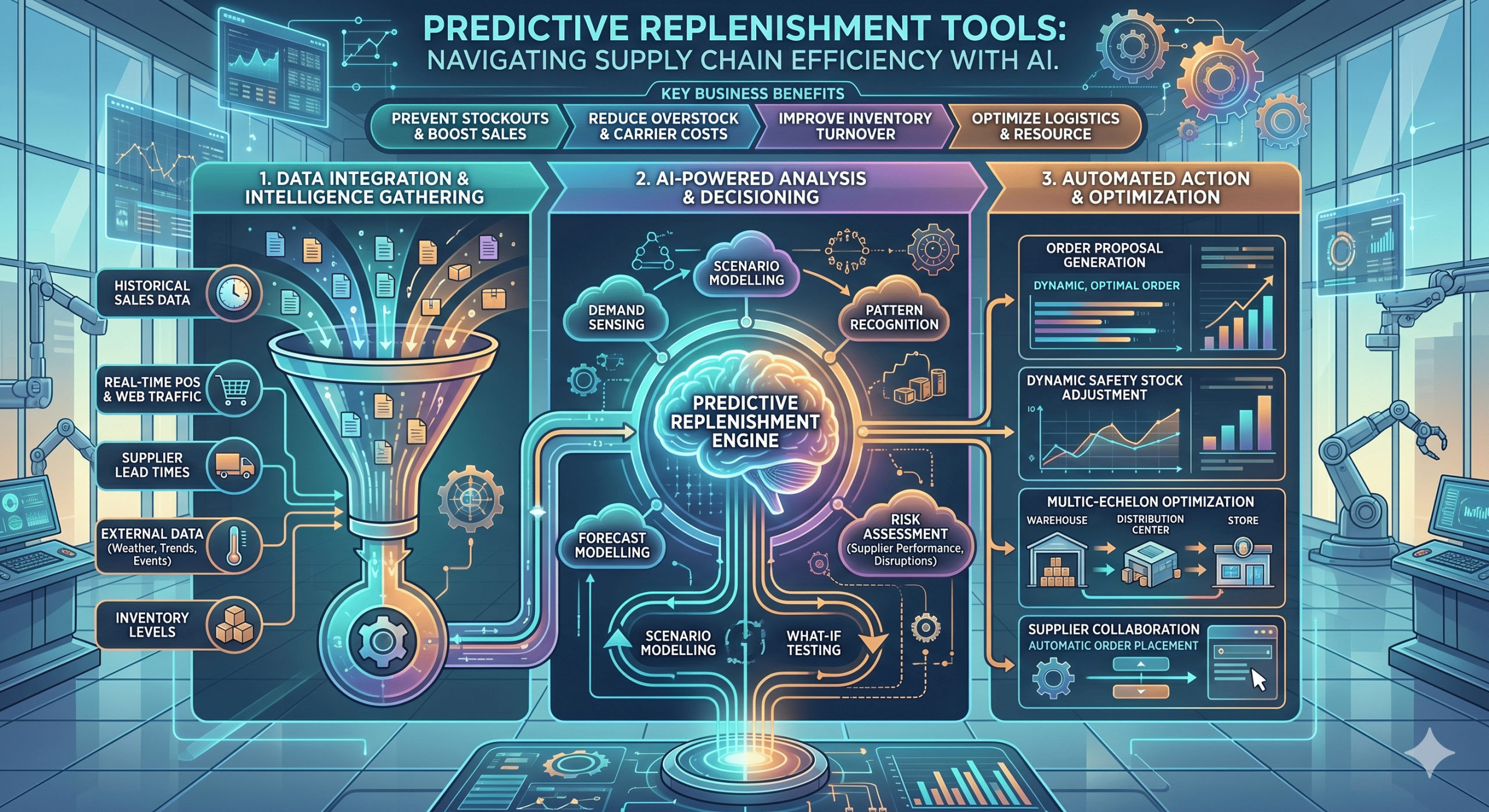
Inventory forecasting has always been one of the most critical components of retail and supply chain management. Every inventory decision ultimately depends on a retailer’s ability to estimate future demand accurately. When forecasts are accurate, businesses can maintain product availability, optimize inventory investments, improve customer satisfaction, and operate more efficiently. When forecasts are inaccurate, the consequences can be costly, leading to stockouts, excess inventory, lost sales, markdowns, and reduced profitability.
Forecasting has become increasingly difficult in today’s retail environment. Customer preferences shift rapidly, product lifecycles are shorter, promotional activity can dramatically influence demand, and external factors such as economic conditions, weather, and social media trends can alter purchasing behavior with little warning. Traditional forecasting methods that rely primarily on historical sales patterns often struggle to keep pace with this level of complexity.
To address these challenges, retailers are increasingly adopting predictive replenishment tool. Powered by artificial intelligence (AI), machine learning, predictive analytics, and real-time demand sensing, these solutions help businesses generate more accurate forecasts and make better inventory decisions. Rather than relying solely on historical trends, predictive replenishment systems continuously analyze multiple demand signals to anticipate future inventory requirements more effectively.
As inventory optimization becomes a strategic priority, predictive replenishment tools are playing a central role in improving forecast accuracy and supporting more agile supply chain operations.
Why Inventory Forecast Accuracy Matters
Inventory forecasting determines how much stock retailers should carry to meet future demand.
Accurate forecasts help organizations:
- Maintain product availability
- Reduce stockouts
- Minimize excess inventory
- Improve customer satisfaction
- Optimize working capital
Forecast accuracy directly influences both revenue generation and operational efficiency.
Even small forecasting improvements can create significant business value.
The Cost of Poor Forecast Accuracy
Inaccurate forecasts often create inventory imbalances that affect multiple areas of the business.
Stockouts
Underestimating demand can leave customers unable to purchase products.
This may result in:
- Lost sales
- Reduced customer satisfaction
- Lower customer loyalty
Excess Inventory
Overestimating demand can create inventory surpluses that increase:
- Storage costs
- Markdown expenses
- Obsolescence risks
- Working capital requirements
Operational Inefficiencies
Poor forecasts often lead to emergency replenishment actions and reactive inventory management.
These outcomes reduce profitability and increase supply chain complexity.
Why Forecasting Has Become More Challenging
Retail demand is becoming increasingly dynamic.
Several factors contribute to forecasting complexity.
Rapidly Changing Consumer Preferences
Customer interests evolve faster than traditional planning cycles.
Omnichannel Retailing
Demand now originates from:
- Physical stores
- Ecommerce platforms
- Mobile applications
- Marketplaces
Each channel may exhibit different demand patterns.
Promotional Activity
Discounts and marketing campaigns can significantly influence purchasing behavior.
External Influences
Demand may be affected by:
- Weather
- Economic conditions
- Competitive actions
- Social media trends
These factors make accurate forecasting more difficult using conventional approaches.
What Are Predictive Replenishment Tools?
Predictive replenishment tools are inventory planning solutions that use:
- Artificial intelligence
- Machine learning
- Predictive analytics
- Real-time demand signals
to forecast future inventory requirements and automate replenishment decisions.
Unlike traditional forecasting systems, predictive replenishment solutions continuously evaluate changing conditions and adjust recommendations accordingly.
This improves forecast responsiveness and accuracy.
Why Traditional Forecasting Methods Have Limitations
Many organizations still rely on forecasting methods based primarily on:
- Historical sales averages
- Fixed forecasting models
- Manual planning processes
- Static reorder points
While useful in stable environments, these approaches often struggle when demand becomes volatile.
Common limitations include:
Delayed Visibility
Historical sales data may not reflect emerging demand trends.
Limited Data Inputs
Traditional models often ignore valuable behavioral signals.
Infrequent Updates
Forecasts may not adjust quickly enough to changing conditions.
Human Bias
Manual forecasting processes can introduce inconsistencies.
These challenges have accelerated the adoption of predictive replenishment technologies.
How Predictive Replenishment Tools Improve Forecast Accuracy
Analyzing Multiple Demand Signals
Predictive replenishment systems evaluate a broader range of information than traditional forecasting methods.
Examples include:
- Historical sales
- Promotional calendars
- Seasonal patterns
- Customer behavior
- Product searches
- Ecommerce activity
This creates a more comprehensive understanding of demand drivers.
Leveraging Real-Time Demand Sensing
Real-time demand sensing is one of the most important advancements in inventory forecasting.
Modern predictive systems analyze signals such as:
- Point-of-sale transactions
- Website traffic
- Product views
- Search activity
- Cart additions
These signals often reveal demand shifts before they appear in sales data.
Earlier visibility improves forecast responsiveness.
Identifying Emerging Trends Earlier
Demand changes often begin gradually before accelerating.
Predictive replenishment tools can identify:
- Growing product interest
- Category demand increases
- Seasonal acceleration
- Emerging customer preferences
Early detection enables retailers to adjust inventory plans proactively.
This improves forecast reliability.
Applying Machine Learning Models
Machine learning enables forecasting systems to recognize patterns that traditional models may overlook.
AI can analyze:
- Historical relationships
- Demand fluctuations
- Product interactions
- Customer behavior
Machine learning models continuously improve as more data becomes available.
This helps increase forecast accuracy over time.
Adapting Forecasts Continuously
Traditional forecasts are often updated weekly or monthly.
Predictive replenishment systems continuously evaluate new information and adjust forecasts dynamically.
This allows organizations to respond more quickly to changing market conditions.
Dynamic forecasting improves inventory precision.
Accounting for Demand Variability
Demand uncertainty varies significantly across products and categories.
Predictive replenishment tools assess:
- Demand volatility
- Product seasonality
- Sales frequency
- Forecast confidence levels
This helps retailers develop more realistic inventory plans.
Supporting Promotional Forecasting
Promotions can significantly alter purchasing behavior.
Predictive systems evaluate:
- Historical promotional performance
- Product elasticity
- Marketing activity
- Customer response patterns
These insights improve demand projections during promotional periods.
Optimizing Safety Stock Levels
Forecast accuracy directly influences safety stock requirements.
Improved forecasts enable retailers to:
- Reduce excess safety stock
- Maintain service levels
- Improve inventory efficiency
This creates a more balanced inventory strategy.
Improving Omnichannel Forecasting
Retailers increasingly serve customers through multiple channels.
Predictive replenishment tools forecast demand across:
- Stores
- Ecommerce platforms
- Mobile channels
- Fulfillment centers
This provides a more complete view of inventory requirements.
Reducing Forecasting Bias
Manual forecasting often introduces subjective assumptions.
Predictive systems use data-driven models to generate recommendations objectively.
This improves consistency and reduces planning errors.
Enhancing Inventory Visibility
Accurate forecasting depends on inventory visibility.
Predictive replenishment solutions provide insight into:
- Current inventory positions
- Inventory in transit
- Future demand expectations
- Replenishment schedules
Better visibility supports more accurate planning decisions.
Benefits of Improved Forecast Accuracy
Higher Product Availability
Customers are more likely to find products in stock.
Reduced Stockouts
Inventory shortages become less frequent.
Lower Excess Inventory
Retailers avoid unnecessary inventory accumulation.
Better Working Capital Utilization
Inventory investments become more efficient.
Improved Supply Chain Efficiency
Planning becomes more proactive and less reactive.
Stronger Customer Satisfaction
Reliable product availability improves customer experiences.
Common Challenges Organizations Face
Data Quality Issues
Forecasting accuracy depends on reliable data inputs.
Demand Volatility
Some demand shifts remain difficult to predict.
System Integration Complexity
Data often resides across multiple platforms.
Organizational Change Management
Teams may need to adapt to automated forecasting processes.
Addressing these challenges is essential for success.
Best Practices for Improving Forecast Accuracy
Leverage Real-Time Demand Signals
Current customer activity improves forecast responsiveness.
Use AI-Powered Forecasting Models
Machine learning enhances prediction accuracy.
Continuously Monitor Forecast Performance
Regular evaluation supports ongoing improvement.
Strengthen Supplier Collaboration
Shared visibility improves planning quality.
Automate Replenishment Decisions
Automation increases speed and consistency.
Key Metrics to Track
Organizations should monitor:
- Forecast accuracy
- Mean absolute percentage error (MAPE)
- Stockout rates
- Inventory turnover
- Service levels
- Fill rates
- Days of inventory on hand
These metrics help evaluate forecasting effectiveness.
Conclusion
Forecast accuracy remains one of the most important factors influencing retail and supply chain success. In an environment characterized by rapidly changing customer behavior, omnichannel commerce, and growing market uncertainty, traditional forecasting approaches often struggle to deliver the precision required for effective inventory management.
Predictive replenishment tools provide a more advanced approach by combining AI, machine learning, predictive analytics, and real-time demand sensing to improve forecast accuracy continuously. These capabilities enable retailers to anticipate demand changes earlier, optimize inventory investments, and respond more effectively to market dynamics.
As supply chains become increasingly data-driven, predictive replenishment tools will continue to play a critical role in helping organizations improve inventory planning, maintain product availability, reduce costs, and support sustainable business growth.