
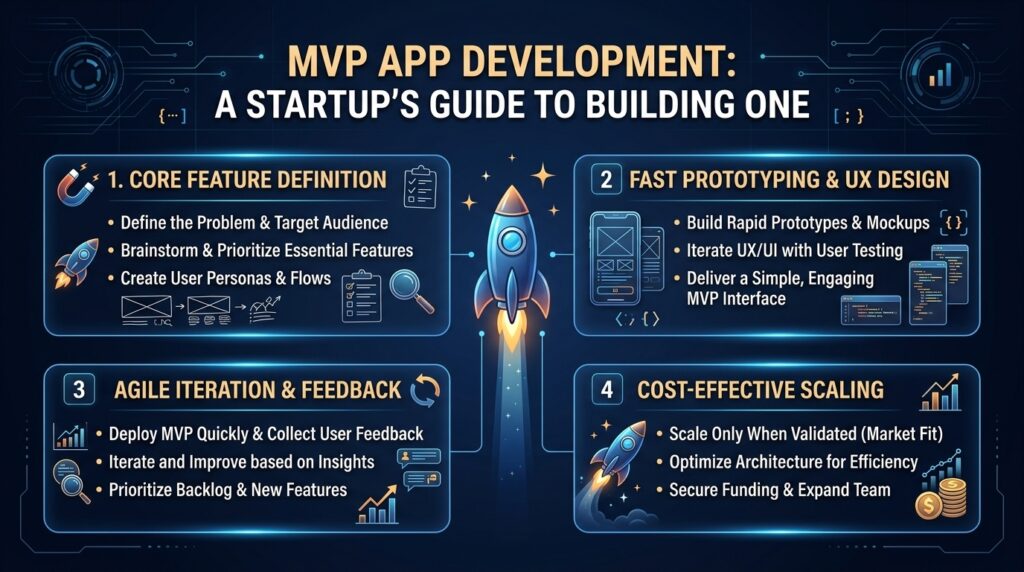
You’ve got an idea. You’ve maybe even got funding, or a founder who’s willing to bet their savings on it. What you don’t have is time or money to burn on features nobody asked for. That’s exactly the problem MVP app development solves.

An MVP — minimum viable product — isn’t a cut-down version of your dream app. It’s the smallest, most honest test of whether your idea actually works. Get this right, and you’ll know what to build next. Get it wrong, and you’ll spend six months polishing something the market never wanted.
Here’s how to approach it properly.
What “MVP” Actually Means (And What It Doesn’t)
An MVP is the version of your product with just enough features to solve one core problem for early users — and nothing more.
It’s not:
- A prototype or wireframe (those aren’t functional)
- A stripped-down beta full of bugs
- An excuse to skip good design or UX
It is a working product that real users can use, pay for, and give you honest feedback on. Basecamp, Airbnb, and Uber all started this way — simple, single-purpose tools that solved one problem well before expanding.
Why MVP App Development Matters for Startups
Founders who skip the MVP stage tend to make the same mistake: they build based on assumptions, not evidence. That’s expensive.
A few reasons MVP-first development pays off:
- Lower financial risk — you’re testing demand before committing a full development budget
- Faster market feedback — real user behaviour tells you more than any survey
- Easier to pivot — smaller builds are easier to change direction on
- Investor confidence — a working MVP with early traction is more persuasive than a pitch deck alone
For UK startups especially, where early-stage funding rounds are often tighter and more scrutinised than in the US, showing traction with a lean MVP can be the difference between securing a seed round and not.
The MVP App Development Process, Step by Step
1. Define the Core Problem, Not the Feature List
Before any development starts, get specific about the single problem your app solves and for whom. If you can’t describe it in one sentence, it’s not focused enough yet.
2. Map the User Journey
Sketch out the minimum path a user takes to get value from your app — sign up, complete the core action, see the result. Every screen or feature outside that path is a candidate for a later release.
3. Prioritise Ruthlessly
Use a simple framework like MoSCoW (Must have, Should have, Could have, Won’t have) to separate what’s essential from what’s nice-to-have. Most first-time founders overestimate what counts as “essential.”
4. Choose the Right Tech Stack
Your stack should match your goal: speed to market, not long-term scalability at this stage. Cross-platform frameworks (like React Native or Flutter) often make sense for MVPs, since they let you launch on iOS and Android from one codebase — cutting both cost and time.
5. Build, Test, Launch — in Weeks, Not Months
A well-scoped MVP should typically take 6–12 weeks to build, depending on complexity. If your development partner is quoting six months, your scope is probably too big.
6. Measure What Matters
Set clear success metrics before launch — activation rate, retention after 7 days, or willingness to pay. Vanity metrics like downloads don’t tell you if the problem is actually solved.
7. Iterate Based on Real Data
Your MVP’s job is to generate evidence. Use that evidence to decide what to build next — not what you originally planned to build.
Common MVP Mistakes to Avoid
- Building for scale too early — you don’t need infrastructure for a million users when you have twelve
- Ignoring UX because it’s “just an MVP” — poor usability skews your data; users will abandon a clunky app regardless of the idea’s merit
- Treating the MVP as the finished product — it’s a starting point, not a destination
- Skipping user research before building — talk to potential users before writing a line of code, not after
Final Thoughts
MVP app development isn’t about building less for the sake of it — it’s about building smart. The goal is to learn as much as possible, as quickly and cheaply as possible, before you commit real money to scaling.
If you’re planning your first build, start with the problem, not the product. The features can come later — once you know they’re worth building.
Ready to turn your idea into a working MVP? Get in touch with our team to scope your build and get a realistic timeline and cost estimate.
FAQs
How much does MVP app development cost in the UK? Costs typically range from £15,000–£50,000 depending on complexity, platform choice, and whether you’re using an agency or freelance developers. Simple single-platform MVPs sit at the lower end; cross-platform apps with backend infrastructure cost more.
How long does it take to build an MVP? Most MVPs take 6–12 weeks from scoping to launch. Complex apps involving payments, real-time features, or third-party integrations can take longer.
Do I need a technical co-founder to build an MVP? No — many successful MVPs are built with an outsourced development team or agency. A technical co-founder helps long-term, but it’s not a hard requirement to get started.
What’s the difference between an MVP and a prototype? A prototype is a non-functional mockup used to test design and flow. An MVP is a real, working product that users can actually use and that generates live data.
Should I build my MVP natively or cross-platform? For most startups, cross-platform (React Native, Flutter) is the faster, cheaper route to launch on both iOS and Android. Native development makes more sense once you need deep platform-specific performance or features.
What happens after the MVP launches? You measure usage, gather feedback, and use that data to prioritise your next development phase — whether that’s new features, scaling infrastructure, or refining the core experience.